

Upcoming events

1
Dec
TI International Anti-Corruption Conference
Punta Cana, Dominican Republic
1 - 4 December 2026
8
Dec
Webinar: Measuring what matters: Driving integrity through monitoring, evaluation and continuous improvement
Online
8 December 2026
News & Events
Webinar series on business integrity continues with a deep dive on transformational governance New York and Vienna, 16 September 2026 - The United Nations Office on Drugs and Crime (UNODC) and the United Nations Global Compact (UN Global Compact) continued their Global Webinar Series on Business Integrity with the first deep dive session dedicated to the implementation of the publication An Anti-Corruption Ethics and Compliance Programme for Business: A Practical Guide in September 2026. The webinar series provide a space for dialogue, peer learning, and knowledge exchange, bringing together business practitioners from around the world to share good practices and discuss current challenges in business integrity. The session, entitled An Integrated Approach: Enhancing Compliance through a Transformational Governance Lens , introduced one of the key innovations of the updated Guide: transformational governance. Transformational governance promotes a more integrated and principled approach to corporate governance, recognizing that anti-corruption, environmental, human rights and sustainability issues are deeply interconnected and should be addressed holistically. The webinar featured insights from business integrity practitioners from different regions and sectors, including Klaus Moosmayer, Member of the Supervisory Board at Deutsche Bank, Pamela Vago, Compliance Manager at Genneia, and Sally Mwenesi, Principal - Fraud Prevention and Ethics at Safaricom. Discussions focused on how organizations can apply a transformational governance approach to strengthen their anti-corruption ethics and compliance programmes. Speakers underlined the importance of moving beyond silos and adopting integrated risk assessment processes that consider emerging risks in a holistic way. To watch the webinar, please access the English recording below. To listen to the French, Portuguese, or Spanish version, create an account here and switch languages by clicking the globe icon in the media player. The second webinar dedicated to the implementation of the publication An Anti-Corruption Ethics and Compliance Programme for Business: A Practical Guide will take place on 8 December 2026 on the topic: Measuring what matters: Driving integrity through monitoring, evaluation and continuous improvement. Sign up here .

Private sector contributes to the first European Union Anti-Corruption Strategy New York and Vienna, 30 June 2026 - Businesses from the Conference of the States Parties to the United Nations Convention against Corruption (COSP) Private Sector Platform and other United Nations Global Compact participant companies joined an online dialogue with the European Commission to share private sector perspectives on the development of the first EU Anti-Corruption Strategy and the implementation of the recently adopted Directive (EU) 2026/1021 on combatting corruption . The dialogue was convened by the United Nations Office on Drugs and Crime (UNODC) and the United Nations Global Compact in collaboration with the Directorate-General for Justice and Consumers (DG JUST) of the European Commission. The event brought together 44 business representatives from companies participating in the COSP Private Sector Platform and other UN Global Compact participant companies. The dialogue contributed to the European Commission's consultation process for the preparation of the upcoming EU Anti-Corruption Strategy which is scheduled for adoption at the end of 2026. Supporting a business environment built on integrity Corruption creates significant legal, financial, reputational and operational risks for companies while undermining sustainable economic growth. Business participants welcomed the opportunity to contribute practical business experience to the development of a strategy that can help create a more predictable and transparent operating environment across the European Union and in their global operations. During the opening session, DG JUST provided an overview of Directive (EU) 2026/1021 on combatting corruption , which introduces harmonized corruption offences, stronger sanctions and enhanced prevention measures for the private sector. Participants also received an update on the ongoing preparations for the first EU Anti-Corruption Strategy. Key business priorities for the future EU Anti-Corruption Strategy Through a series of breakout discussions, participants identified practical challenges and opportunities across several areas relevant to business integrity. An important theme was the need for more consistent implementation and enforcement of anti-corruption rules across Member States. Companies emphasized that fragmented regulatory frameworks, differing definitions and overlapping compliance requirements can create uncertainty and increase the cost of compliance. Participants called for clearer guidance and greater harmonization to support the effective implementation of anti-corruption requirements. In this regard, the recently launched An Anti-Corruption Ethics and Compliance Programme for Business: A Practical Guide developed by UNODC and the UN Global Compact can be a helpful resource. Businesses also highlighted corruption risks linked to third parties, intermediaries, distributors, agents and public procurement. Discussions underscored the importance of addressing corruption from both the supply and demand side, including strengthening public sector integrity as a foundation for a competitive and innovative market environment. Participants further emphasized the value of incentives that encourage companies to invest in credible anti-corruption ethics and compliance programmes, self-report misconduct and cooperate with authorities. This discussion echoed approaches highlighted in the UNODC-UN Global Compact Resource Guide on State Measures for Strengthening Business Integrity, a useful tool for governments for encouraging business integrity by identifying and implementing a mix of sanctions and incentives. Companies further stressed the growing challenge of identifying and managing corruption risks throughout increasingly complex global value chains. They advocated for a whole value chain approach and highlighted the need to align anti-corruption due diligence with broader corporate governance processes. They also emphasized the importance of supporting small and medium-sized enterprises (SMEs) through practical guidance, digital tools and capacity-building initiatives: a shared responsibility for the public and private sectors. The dialogue also explored the role of technology and artificial intelligence in strengthening business integrity. Participants recognized the potential of AI to improve corruption risk identification and monitoring. At the same time, companies highlighted the need for practical guidance, safeguards and responsible governance frameworks to ensure the ethical use of artificial intelligence in the sensitive area of compliance. Strengthening public-private cooperation and collective action A strong message emerging from the discussions was the value of public-private cooperation and collective action. Participants identified opportunities for collaboration in public procurement, beneficial ownership transparency, due diligence data sharing, SME support and the development of common standards, also with a view to using AI ethically in compliance. Companies also expressed willingness to contribute practical experience, risk assessment methodologies, emerging risk trends and lessons learned to support evidence-based policymaking. The dialogue resulted in an outcome document with a series of recommendations that can be accessed here. Additional Resources An Anti-Corruption Ethics and Compliance Programme for Business: A Practical Guide A Resource Guide on State Measures for Strengthening Business Integrity Integrity Engine Project UN Global Compact Anti-Corruption Collective Action initiatives Directive (EU) 2026/1021 on combatting corruption
A new Think Lab explores the potential of artificial intelligence New York and Vienna, 18 June 2026 - A new United Nations initiative is bringing together leading companies and experts to explore how artificial intelligence (AI) can strengthen anti-corruption ethics and compliance programmes in business. Launched on 18 June 2026, the Think Lab on AI for Business Integrity, co-led by the United Nations Office on Drugs and Crime (UNODC) and the United Nations Global Compact , brings together 34 companies from 22 countries, alongside academia, to advance the responsible use of AI for business integrity. From global priorities to concrete action The Think Lab builds on recent global milestones that have shaped the current business integrity agenda. At the Private Sector Forum held on the margins of the eleventh session of the Conference of the States Parties (COSP11) to the UN Convention against Corruption, business leaders, policymakers and experts highlighted the transformative potential of AI, innovation and collective action for anti-corruption efforts. Key priorities identified included: guidance on using AI for business integrity, the ethical use of AI in compliance functions, and implications for young professionals and the future of the compliance profession. These priorities are now taken up by the new Think Lab. In March 2026, UNODC and the UN Global Compact released the updated global standard, An Anti-Corruption Ethics and Compliance Programme for Business: A Practical Guide . The Guide provides a comprehensive framework for effective compliance programmes in a rapidly evolving risk landscape. The Guide highlights AI as an emerging area requiring more practical guidance. A collaborative platform for innovation Responding to this need, the Think Lab serves as a platform for collective learning, knowledge exchange and innovation. It will explore how to advance AI as a tool for business integrity while ensuring its ethical and responsible use. At the kick-off meeting, participating companies discussed key objectives and priorities, exchanged experiences on the use of AI in compliance, and identified practical challenges and emerging risks. Building on these discussions, participants will work together to develop practical guidance on leveraging AI to strengthen anti-corruption ethics and compliance programmes, address ethical considerations and safeguards in the use of AI for business integrity, and explore real-world applications and case studies. Looking ahead Over the next 18 months, the Think Lab will convene companies and experts through working sessions, in-person and online consultations and research activities to produce concrete outputs. These results will contribute to global discussions and are expected to be presented at the COSP12 Private Sector Forum, scheduled for December 2027 in Uzbekistan. Read more Publication: An Anti-Corruption Ethics and Compliance Programme for Business: A Practical Guide UNODC Project overview: Integrity Engine

Zurich, Switzerland - April 2026 In April, the UN Global Compact and UNODC continued engagement with COSP Private Sector Platform participants at the Global Ethics and Compliance Symposium 2026 in Zurich, Switzerland. Convened on 14–15 April as a hybrid event, the symposium was organized by the PRME Business Integrity Action Center at the University of Applied Sciences of the Grisons (FHGR), the PRME Working Group on Anti-Corruption, Ethics and Compliance Switzerland, and the UN Global Compact. It brought together leaders from PRME, the UN Global Compact, academia and civil society to explore how stronger collaboration can advance anti-corruption, ethics and business integrity through research, capacity-building and collective action. A dedicated side event, The One Global Compact Strategy Workshop: Shaping the UNGC & PRME Collaboration with the New Head of PRME , featured David Steingard, Cristina Ritter, Antonio Hautle and Christian Hauser, and focused on strengthening collaboration across PRME, UN Global Compact Country Networks, business schools and external partners. The symposium also explored a number of themes highly relevant to the COSP Private Sector Platform’s future work, including navigating geopolitical fragmentation, moving ethics and compliance from cost centre to value driver, and steering organizations through an AI-powered future. The symposium included engagement from COSP Private Sector Platform participant companies, including David Nuñez of FCC Construcción and Alexandra Levchenko of DTEK.

Paris, France - March 2026 On 26 March, the UN Global Compact convened One Global Compact: A Shared Commitment to Business Integrity on the sidelines of the OECD Global Anti-Corruption and Integrity Forum (GACIF) in Paris, France. Organized in partnership with Global Compact Networks France, Brazil, the United Kingdom, Argentina and Georgia, the event brought together companies, government representatives, NGO partners and civil society to exchange perspectives on practical mechanisms for implementing business integrity. The programme featured remarks by UN Global Compact Board Member and Transparency International Chair François Valérien, followed by a panel discussion with members of the COSP Private Sector Platform: Shawn Teixeira of the Siemens Integrity Initiative, Christie Ippisch of Progreso Cemento, and Alexandra Levchenko of DTEK. A networking reception followed, fostering collaboration and synergies across sectors. In addition, ten participants from the COSP Private Sector Platform gathered for an informal working lunch on the sidelines of GACIF to discuss next steps for the Platform, including preparations for the UN Global Compact Leaders Summit in New York in September.
Doha, Qatar - 16 December 2025 At the Eleventh Conference of States Parties (COSP11) to the United Nations Convention against Corruption (UNCAC), held in Doha, Qatar, under the theme "Shaping Tomorrow's Integrity," a groundbreaking mechanism was born on 16 December 2025. The COSP Private Sector Platform (PSP), co-led by the UN Global Compact and the United Nations Office on Drugs and Crime (UNODC), was officially launched as the first structured, sustained space for government-business collaboration within the COSP framework. As a new mechanism, the COSP Private Sector Platform brings together 22 leading companies across industries and regions providing a space for companies to exchange good practices and address shared challenges, collaborating with governments in promoting business integrity worldwide. Its work is grounded in UNCAC, Sustainable Development Goal 16, and the UN Global Compact Principle Ten on combating corruption in all its forms, including extortion and bribery. It provides a structured, year-round avenue for businesses to contribute meaningfully to UNCAC implementation and follow relevant COSP resolutions, such as Resolution 10/12 , which called for stronger public-private partnerships in anti-corruption. The launch took place within the framework of the Private Sector Forum (PSF), a high-level event jointly organized by UNODC and the UN Global Compact since COSP10 in December 2023, bringing together business leaders, government representatives, civil society, academia, youth and international organizations to address pressing anti-corruption challenges. During the second Private Sector Forum at COSP11 in December 2025, the forum brought over 300 corporate participants to discuss the transformative role of artificial intelligence (AI), digital tools, and cross-sector partnerships towards strengthening transparency, accountability and ethical business practices worldwide.
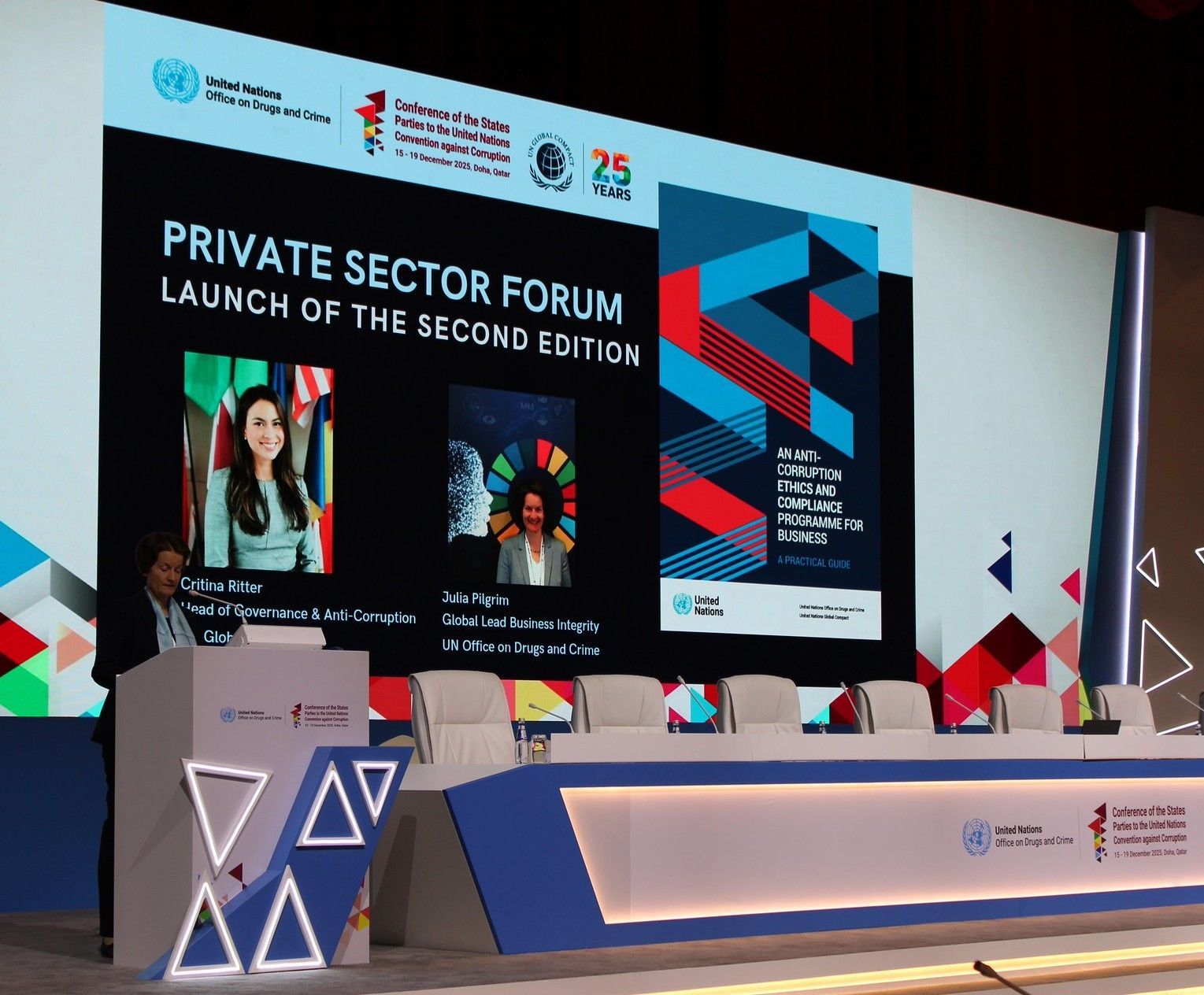
Doha, Qatar The United Nations Global Compact and the United Nations Office on Drugs and Crime (UNODC) convened the COSP11 Private Sector Forum today in Doha, Qatar, bringing together business leaders, government representatives, civil society, academia, youth and international organizations to confront emerging challenges in anti-corruption and business integrity. Held under the theme “Future-Proofing Business Integrity: AI, Innovation and Global Collaboration”, the Forum underscored the transformative role of artificial intelligence (AI), digital tools and cross-sector partnerships in strengthening transparency, accountability and ethical business practices worldwide. Participants examined how AI, blockchain, data analytics and other emerging technologies are revolutionizing compliance—from reactive monitoring to proactive, values-driven practices. These tools are enabling companies and regulators to detect irregularities, flag suspicious transactions and uncover hidden networks of illicit activity with unprecedented speed and accuracy. Discussions also emphasized the potential of digital innovation to foster real-time accountability, enhance youth and citizen engagement, and create new opportunities for knowledge-sharing. The sessions were presented in partnership with leading organizations such as the World Bank, OECD, Transparency International, Alliance for Integrity, Basel Institute on Governance, MACN, CIPE and the International Chamber of Commerce (ICC). Commenting on the day’s proceedings Sanda Ojiambo, CEO and Executive Director of the United Nations Global Compact, said: “As corruption grows more complex, so too must our response. Artificial intelligence and digital innovation are powerful tools to safeguard integrity, but they must be grounded in responsibility, transparency and collective action. Through the COSP Private Sector Platform and initiatives like today’s Forum, we are ensuring that companies not only adapt to these new realities but also lead the way in building markets that are fair, transparent and accountable. This is essential not only for business competitiveness but also for achieving the Sustainable Development Goals.” Collective Action Driving Systemic Change The Forum showcased the effectiveness of Collective Action initiatives that unite businesses, governments, academia, youth and civil society in addressing systemic corruption risks. Through their experience, the speakers demonstrated how trust-based collaboration, reinforced by innovative technology, can raise integrity standards, strengthen markets and ensure fair competition. Speakers highlighted the critical role of such initiatives in advancing Sustainable Development Goals 16 (Peace, Justice and Strong Institutions) and 17 (Partnerships for the Goals). Launch of the COSP Private Sector Platform A key milestone of the eleventh session of the Conference of the States Parties to the United Nations Convention against Corruption (COSP11) was the launch of the COSP Private Sector Platform, co-led by UNODC and the UN Global Compact. This new mechanism provides a structured, year-round avenue for businesses to contribute meaningfully to UNCAC implementation and follow relevant COSP resolutions, such as Resolution 10/12, which called for stronger public-private partnerships in anti-corruption. At the Forum, the Platform outlined private sector commitments to strengthen anti-corruption efforts and identified priority initiatives to be developed into concrete projects in the coming years, with UNODC and the UN Global Compact supporting their implementation.

For the second time, the UN Global Compact and the United Nations Office on Drugs and Crime (UNODC) will host the Private Sector Forum on the margins of the Conference of the States Parties (COSP) to the United Nations Convention against Corruption (UNCAC) from 15-16 December 2025, in Doha, Qatar. The 2025 Private Sector Forum will bring together business leaders, Government representatives, and international organizations to explore how artificial intelligence and emerging technologies can transform anti-corruption efforts while addressing critical ethical challenges. Through interactive sessions and multi-stakeholder discussions, participants will share concrete innovative solutions for strengthening business integrity while shaping the global business integrity agenda through global collaboration. For more information about the 2025 Private Sector Forum, please see: https://businessintegrity.unodc.org/bip/en/private-sector-forum-at-cosp11.html . To register, kindly fill out the form here .
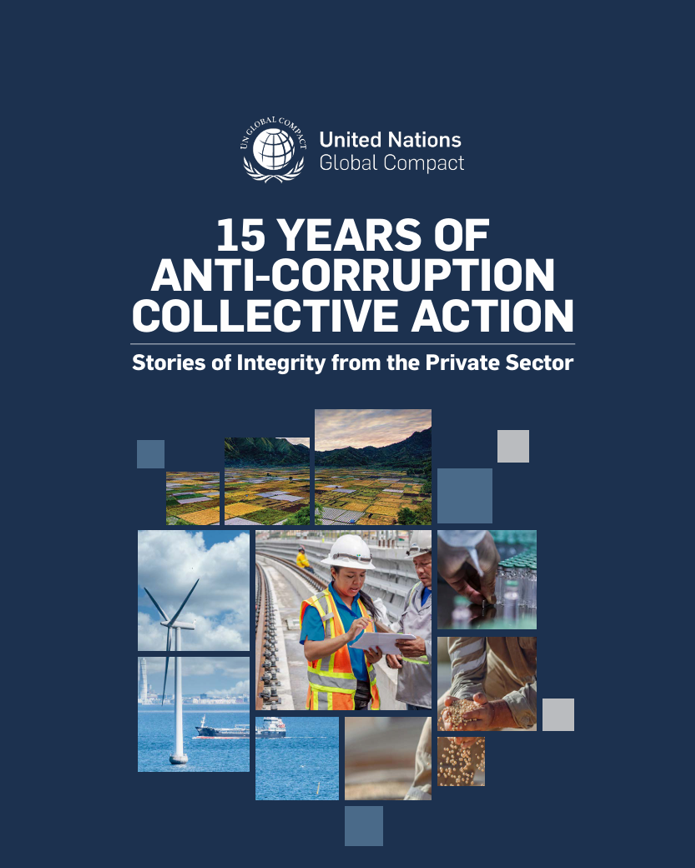
Mexico City, Mexico The United Nations Global Compact commemorated the successful conclusion of its 15-year Anti-Corruption Collective Action (ACCA) initiative at a special two-day event held on 26–27 June. Funded since its inception in 2010 by the Siemens Integrity Initiative, the project commemorated a remarkable journey of promoting business integrity and combating corruption across the globe. The event brought together a diverse group of more than 100 leaders from business, Government, international organizations, academia and civil society, hosted in collaboration with UN Global Compact Country Networks Mexico and Brazil. Discussions highlighted powerful achievements and valuable insights derived from ACCA initiatives implemented by 13 Global Compact Country Networks. A cornerstone of the event was the launch of the comprehensive legacy report, 15 Years of Collective Action: Stories of Integrity from the Private Sector . The report captures global impacts through compelling narratives that vividly illustrate how cross-sector collaboration has tangibly transformed business practices, enhanced transparency and fostered ethical leadership worldwide. Sanda Ojiambo, CEO & Executive Director of the UN Global Compact, stated: “The Anti-Corruption Collective Action initiative has proven that integrity is not just good ethics — it's good business. Corruption erodes trust, weakens institutions and hampers sustainable development. Collective Action has demonstrated its power to align companies, Governments and civil society behind a shared vision of transparency and accountability. As we commemorate these successes, we reaffirm our call for continued collaboration to sustain momentum towards a more equitable and ethical global economy.” Key highlights from the event and legacy report include: 1 . Collective Action as a Driver of Sustainable Development : The ACCA initiative underscored the vital role of collaboration in achieving the Sustainable Development Goals, particularly SDG 16 on peace, justice and strong institutions. Participants reiterated how partnerships have multiplied individual efforts, creating lasting improvements in governance and corporate responsibility. 2. Impact through Storytelling: By harnessing the power of storytelling, the legacy report connects audiences to the real-world impacts of anti-corruption efforts. Personal accounts from business executives, community leaders and stakeholders offer insights into how ethical practices have reshaped corporate cultures and communities, making the case for continued global cooperation. 3. Ongoing Commitment to Transparency and Integrity: Recognizing the enduring importance of Collective Action, participants highlighted the need for continued engagement and knowledge sharing. The event also spotlighted resources such as the Uniting against Corruption: A Playbook on Anti-Corruption Collective Action, the ACCA e-learning course and the Doing Business with Integrity course designed to foster transparency and guide future initiatives. The report features stories organized by key themes, including Engaging the Next Generation of Ethical Leaders, Harnessing Digital Technology for Transparency, and more. Each theme is illustrated with real-world examples of how the project strengthens good governance, builds trust and promotes business integrity in various sectors globally. The UN Global Compact, as a leading voice in Collective Action, has consistently emphasized the importance of collaboration across sectors to combat corruption and promote integrity. ACCA has catalyzed widespread change and established Collective Action as a vital framework for addressing complex global challenges like corruption. Looking ahead, the UN Global Compact calls on companies worldwide to join forces in scaling up anti-corruption efforts. Download the 15 Years of Collective Action: Stories of Integrity from the Private Sector to learn more about the progress made since 2010 by the Siemens-backed Anti-Corruption Collective Action (ACCA) project of the UN Global Compact. With stories from 13 different countries across Africa, Asia, Europe and Latin America, the ACCA Legacy Report serves as a testament to how trusted private sector partnerships can transform industries, drive long-term success and protect people. Read the full press release here .

Developed by Global Compact Network Kenya in collaboration with the Kenya Association of Manufacturers and the Kenya Private Sector Alliance, this private-sector-led initiative is rooted in the Ten Principles of the UN Global Compact. It stands as a powerful example of how Collective Action can drive business integrity and ethical leadership.